Slow Burn

Mar. 14th, 2012 07:09 pm
davidklecha: Listening to someone else read the worst of my teenage writing. (penguicon)

As of this fall, I’ll have been “on the internet” for 17 years, pretty much uninterrupted. (The longest single break I had was Boot Camp in 1999.) I think that’s probably enough time to have a good idea of how the internet has shaped discussions and changed how we interact with one another, and further to figure out how to react and respond to it.

The first thing to note is how intoxicating the rapid back-and-forth discussions can feel, at least for me, on the internet. In person, I really love long, in-depth discussions, and relish them when I find them. The exchange of ideas and information spurs the brain to action and stimulates the imagination. I’m not sure precisely what’s different about blog- and forum- and Twitter-based discussions, but there is something there, maybe with just enough isolation from the other people involved, but enough immediacy to make a rapid response the expectation.

Now, to me, that’s often led to a heated atmosphere in online discussion. Again, something about the combination of immediacy and distance creates a friction that can (often but certainly not always) create an atmosphere that is really the opposite of conversation and rational debate. In some ways, I suppose it just intensifies certain human behaviors, but at least for me personally, I’m thinking they’re the sort that can use some ratcheting down of intensity. Being more slow and deliberate allows the opportunity to let arguments and counterpoints sink in, time to digest as it were, and maybe lead to more fruitful responses.

This is, basically, antithetical to how the observed internet culture works currently. Rather than allowing conversations to slowly grow and evolve, for facts to be uncovered, for analysis to be teased out, blog posts have to be commented on within 48 hours or not at all (with occasional exceptions). A Tweet is old news by the time six or eight hours have gone by. Everything has to burn hot, intense, immediate… and then we forget about it. Protests are firestorms of activity, followed by (at best) low simmering discontent, if not cool apathy.

I’d like to change that, at least with myself. And as far as manifestos go, that’s not all that inspiring, but what the heck. It’s how I’m deciding to interact with the flow of information (for the most part), and the rest of the world can follow me or not. I am hoping, though, that it will lead to more robust and thoughtful commentary from me, if not necessarily the most timely.

Mirrored from Bum Scoop.
davidklecha: Listening to someone else read the worst of my teenage writing. (penguicon)

Just a little chest-clearing, real quick, if I may (and I may, it’s my damn blog).

I’ve noticed this meme a few times in the last couple of months; coming along with the SOPA/PIPA blackouts, and with the Ocean Marketing fiasco. In formulation, it went something like this: “Oh sure, you all can get up in arms enough to protest this kind of dick move thing, now why can’t you get all worked about my pet issues?” And, on some level, I agree, especially with the protests of the Ocean Marketing douchebag. That might have gone over the top. But, you know, there’s a point short of over the top. Probably somewhere near, you know, the top, where you achieve critical mass and inspire people to make a change. And I think the sort of person I paraphrased above would probably still think it too much fury over too small an issue.

But here’s the thing, and I wish people would understand this better: it’s not that the same number of people don’t get worked up over other issues, it’s just that so few issues are as clear cut as a marketing douchebag talking to a customer like a condescending asshole (with a poor grasp of spelling and grammar). It’s really easy to get behind that. Same with SOPA and PIPA. The only people who might have really supported those bills were those who didn’t understand them (and thus not invested enough to protest or counter-protest) and the accountants running Hollywood.

Most other issues have been a crapshoot.

And that’s okay, on some level. As much as I might like there to be greater consensus on really important things, like taxes and healthcare and war (not that SOPA wasn’t critical, actually), the lack of consensus is the result of living in a multi-cultural society. It’s part of the bargain. A maddeningly frustrating part, sometimes, especially when we do see people coming together and making that kind of concerted effort. But, part of the bargain, just the same.

Mirrored from Bum Scoop.

FauxWriMo

Nov. 18th, 2011 10:35 am
davidklecha: Listening to someone else read the worst of my teenage writing. (penguicon)

This year, unlike, I think, the last two years, I’m only sort of participating in NaNoWriMo. I actually started the novel I’m working on back in September when I came out of a very productive retreat having thought really hard about working on three different first chapters for three different novels, and ended up just writing one of them well beyond that first chapter. And that’s the typical trap I fall into with NaNoWriMo, not being sufficiently detached from projects in order to focus on a NaNoWriMo-dedicated project, but still kind of wanting to participate in the write-ins and community of the adventure.

(I’m very big on the community of writers–it’s one of my favorite bits of the whole thing, apart from the writing itself.)

The funny thing is, even though I’m expressly not doing an actual NaNoWriMo this year, I have been writing every day, and that’s thanks in no small part to a website called 750Words, which has taught me, in a weird way, how to finally turn off the internal editor and get busy on the process of drafting. It achieves this, in part, by handing out faintly ridiculous little badges which is like crack for a videogame-trained mind. (There’s a much lighter version of this called WrittenKitten, which I found through my sister pointing it out to a friend of ours who wanted a lower pressure version. Simply put: write 100 words, get a picture of a kitten. Write more, more kittens.) I don’t usually write every day, I probably haven’t written every day for more than a week or two probably since I was in high school.

But this month I have and I’m somehow doing it without burning out. So far. It’s a nice feeling, and I hope to keep it going beyond November.

Mirrored from Bum Scoop.

davidklecha: Listening to someone else read the worst of my teenage writing. (penguicon)

Here’s a link to what appears to be an Obama 2012 campaign Google+ account.

Here’s a link to a public discussion on a friend of a friend’s Google+ account.

(Quick recap: Obama account appears to be reposting legit Twitter stuff. The discussion features “Obama”–supposed to be a campaign staffer no doubt–rebutting the notion that all Muslims get blamed for terrorism perpetrated by a Muslim, but not all Christians get tarred with the same brush when a Christian commits an act of heinous violence. In rebutting it “Obama” says that the violence is based in the “quran” and so on, but Christian killers are just lone crazies, not following any commands from the Bible.)

So… either there’s a campaign staffer who is way, way, way off message… or someone has set up a reverse-astro-turf account.

Hey Google, how about getting the President to prove that it’s him?

Mirrored from Bum Scoop.

davidklecha: Listening to someone else read the worst of my teenage writing. (penguicon)

I feel like I’ve blogged on this before, but… I don’t feel like losing the rest of my day to my blog/LJ archives, so I’ll just pretend it’s new. Well, it’s at least an ongoing problem so it’s always relevant.

Anyway, my problem is this: I use too many computers.

Part of that is occupational. I’m an IT guy after all, and it’s hard not to hear the siren call of a new computer when the current one gets the slightest bit clunky or unwieldy. But, I also have a situational computing situation–a desktop with a big monitor that I use for gaming and writing, a laptop that was…charitably financed by a family member while I was laid off, and a work laptop significantly more powerful than the personal lappy that I probably do a little too much personal stuff on.

Naturally, what this amounts to is needing documents, browsing, and e-mail to be the same on all three PCs. Documents I’ve solved through Dropbox, which also works as an automated backup and phone-based viewer. Browsing has improved thanks to Firefox 4, which now offers a secure sync service, syncing bookmarks and saved passwords and such between PCs. That’s very nice.

But e-mail is my strange downfall. I tried GMail, but it just doesn’t quite organize things the way I like to be organized. I like that their labels/tags vs. folders concept, in theory, but in practice I think I’m just mentally bound to the idea of buckets to drop my stuff in, and frankly not enough of what I get e-mailed about is so deeply interconnected that I need to find it in both places. Just… not really a thing with me. Not mention that I’m just plain leery of the whole cloud thing. By default, I would just rather have everything accessible offline with a minimum of possible fuss.

So, I’ve also tried several times to work with PortableApps, with varying success. I like Thunderbird well enough that it makes this doable, but I also don’t like having my e-mail and junk on an easily-lost-or-destroyed thumbdrive. I could go get an IronKey or something like it, so I’d know my data was safe if I lost it… but I’d rather not be in a position to lose it in the first place.

Then I hit on the idea of installing PortableApps inside my Dropbox and, while that’s kinda cool… it’s not, really, and I need something else to do.

So, right now, instead, I’m thinking about doing the remote desktop type solution. The big advantage, of course, is that if I want to look into things from my work computer, which helps keep things more neatly separated. The only problem with that is the annoying latency of working in that kind of environment, but I suppose such is the life of the digital nomad.

Someday, someday I’ll have this all figured out.

And then I’ll get a Mac.

Mirrored from Bum Scoop.

davidklecha: Listening to someone else read the worst of my teenage writing. (Default)

Last night Kathryn Allen posted a rather interesting story about an attempt at phone-based scareware. I’ve been dealing a lot with scareware on the job(s) the last couple of years. This is the kind of stuff that pops up as you’re visiting a website and tells you that your computer has 323 viruses found or something. And you click it and it downloads what looks like a real virus scanner, and shows you all these viruses and malware and such. And you can get rid of them, but only if you pay them $29.99…

Kathryn actually got a phone call from a guy named “Ben” who told her he was from Microsoft and they were proactively trying to help out with error messages that had been reported to Microsoft.

Which, itself should be a red flag for anyone because, typically, you have to tell Windows to send any error reports. And, typically, it tells you in the dialogue box that it won’t send any personal information, so how exactly does Microsoft know to call you…? Well, of course, they don’t. So, as Kat says, if you get a call from Ben or one of his ilk, tell him to take a hike.

Mirrored from Bum Scoop.

davidklecha: Listening to someone else read the worst of my teenage writing. (Default)

One of my biggest pet peeves are those e-mail forwards that breathlessly purport outrageous facts, usually with the subtext of, “They’re all out to get us!” I remember particularly one which seemed popular when I was in college back in the late 90s that peddled screaming outrage over an effort by some atheist somewhere to keep Christian radio stations off the air.

So I guess I wasn’t surprised when I heard that those Hutaree idiots were stoked up in part by a rumor that Obama had signed a $20billion law to resettle Hamas members in the US. (Here’s factcheck.org’s rundown of the rumor.)

I suppose there’s a lot of “what this all means” in here, but at the end of the day, it’s just one of those things where you have to ask yourself where the rumor is coming from. How many friends of friends of friends did it pass through? And, unfortunately, it also means you have to think for yourself even when authority figures push out the same kind of thing. Which in turn seems like something these Hutaree jokers weren’t too good at.

Mirrored from Bum Scoop.

davidklecha: Listening to someone else read the worst of my teenage writing. (Default)

Like a stupid smiling thing, every time I watch it. Enjoy, if it does the same for you:


Mirrored from Bum Scoop.

davidklecha: Listening to someone else read the worst of my teenage writing. (Default)

The vast majority of my WordPress comment spam comes in to this post about Howard Tayler. Don’t know why–maybe because of his overwhelming popularity on the internets.

In other blog housekeeping news, I’m going to add a Twitter plugin for the sidebar. And I upgraded to 2.7.1 on Wordpress without a hitch. I’m digging the new back-end lay out, an improvement over 2.5, which itself was a vast improvement over prior versions.

Mirrored from Bum Scoop.

A Wish

Apr. 20th, 2009 10:47 am
davidklecha: Listening to someone else read the worst of my teenage writing. (Default)
(Testing the Dreamwidth Crossposter, like a good beta tester)

I would love to have, for my work laptop screensaver, a 3D fly-through of the notional internet. You know, there could be a giant Google-branded pyramid in the center and millions of little Google-branded spiders crawling all over everything. 4chan would be a swirling vortex of suck, and Apple's tower would all be shiny and elegant. Dreamwidth could be a small collection of huts out on the frontier, while you could watch LiveJournal getting picked up and moved from place to place. Microsoft would be this massive hodge-podge of components, all with the same blue paint job, but still looking like it could collapse in on itself at any moment.

And then I could sit there and pretend that I'm hacking the planet like they did in all those bad 90s movies about hacking the planet.

That would be awesome

Blog Rec

Dec. 16th, 2008 02:27 pm
davidklecha: Listening to someone else read the worst of my teenage writing. (Default)

One of the nicest guys I knew in the Marines has started a blog, chronicling his return to Iraq as a civilian contractor. He’s a foreman, supervising laborers on an unspecified base somewhere in that dusty sandbox. He seems to have a thing for dumpsters. Check him out at http://jimpetersen.blogspot.com.

Also, beware of the December 10 post.

Don’t say I didn’t warn you.

Crossposted with klech.net

Two Things

Oct. 19th, 2008 08:10 pm
davidklecha: Listening to someone else read the worst of my teenage writing. (Default)

The first, did you know Skippy has a blog? That’s Skippy of Skippy’s List: 213 Things Skippy Can’t Do. I think my personal favorite of the list may be #201: “Must not valiantly push officers onto hand grenades to save the squad.” But that’s just me. Anyway, Skippy seems to have gotten a blog, along with a few others, and it looks like pretty cool stuff, including user-submitted lists.

Sadly, I don’t think I was forbidden to do anything while I was in, other than that one time I was told I’d have all-night firewatch again if I said “actually” one more time… though in retrospect, I was being kind of annoying that day. Not my fault though that everyone else kept being wrong. Sheesh.

Anyway, in addition to that, linked from Skippy’s blog is a webcomic called Lawn Darts which seems to be following an Army (or National Guard/Reserve maybe?) Blackhawk unit as they deploy to Iraq. And, on the left of their page you’ll notice a bunch of other linked military webcomics, which I haven’t had a chance to go through yet and thus cannot recommend. But go read Lawn Darts. Oh, and this here is my favorite so far.

Crossposted with klech.net

Twitter?

Aug. 3rd, 2008 10:17 pm
davidklecha: Listening to someone else read the worst of my teenage writing. (Default)

There’s more I’m sure I’ll be blogging about this week, but for now I just wanted to say that I’ve caved into the complete lack of peer pressure and gotten a twitter account. Username, imaginatively, is davidklecha. I know, shocking, right?

Follow me at your peril.

Crossposted with klech.net
davidklecha: Listening to someone else read the worst of my teenage writing. (Default)

Jason Stoddard, who is fast becoming one of my favorite science fiction people, has a tidy little call for action up on his blog. Succumbing to sweet temptation, he resorts to the old Top Ten list (and if David Letterman ever manages to get a cut of that action, he’ll dwarf Gates’ net worth in no time flat) to outline the things he thinks science fiction as a community can do to improve its standing, and the first five seem pretty easy.

So easy, in fact, that I think a lot of organizations are already jumping on #9 on his list, creating social networks. Baen has had mad success with Baen’s Bar, Tor is fixing to launch their own thing soon, SFWA now has a limited presence on LiveJournal and several magazines and book publishers use MySpace for bringing together readers and flogging new material.

The irony that’s long been tossed around is that there are so many science fiction and fantasy authors, “visionaries” to potentially abuse a term, that seem to be seriously intimidated by current trends in marketing, distribution, and technology. The practical result, I think, is that SFWA’s web presence looks as though it was cutting edge in 1995 (an upgrade from the previous incarnation which looked run-of-the-mill for 1994), a website designed by committee and bargain-basement prices because no one can agree on how important that presence is.

Whether or not it’s SFWA’s job to provide an appropriately cutting-edge face for science fiction and promote the work of its members is a separate question, and yet one that should probably be settled one of these days. I suspect that picture might come clearer following the coming elections.

Anyway, as usual Jason makes a lot of sense. The only potential question I have for his agenda is where the leadership is supposed to come from. SFWA seems a natural, and thus we again have a call to answer the question above, but has been sorely lacking and may never be up to the task. Even if they get their house in order, SFWA is going to spend a long time looking inward and checking to make sure they are doing best by the authors under the group’s current mandate. Expanding that to any kind of outreach type mission will be problematic at best.

So where is that leadership going to come from?

I don’t know, but it seems increasingly likely that it will end up being a loose association of interested parties who are going to take on some of these challenges from outside of the SFWA (and perhaps traditional publishing?) framework. I think John Scalzi and Cory Doctorow have already started down that road, in some fashion, and I think a lot of folks are eager to follow. Whether this informal evangelism of SF produces any converts is another open question, but one that can only be answered over time.

Crossposted with klech.net

So Yeah

Mar. 25th, 2008 10:36 am
davidklecha: Listening to someone else read the worst of my teenage writing. (Default)

Maybe I’m back to blogging. We’ll see how it goes. The kids are healthy again, and we’ve settled once more into a routine of sorts, but we’ll see how long it lasts.

Speaking of blogging, one of the cooliest writer peeps out there, Mer Haskell, has elected to collapse her blog and LiveJournal into one, favoring the LJ. You can find her there as fairmer (pronunciation guide: the name rhymes with itself). There’s been a lot of angst out there about LJ, but rest assured I wasn’t blogging the other day because I haven’t been blogging the past couple weeks, not because I was joining the so-called strike.

As far as that goes, my mind is aligned with Ferrett’s. No one of consequence noticed, I guarantee. And really, I don’t mind there being some kind of minor hurdle to social networking sites like this. Signal-to-noise is something that’s been a problem on the internet since the beginning, only now companies are starting to depend on the signal side of the ration for their livelihood, even if they are Russian.

MySpace is still free, but heavily ad-supported… and they attract a demographic that will click on any damn thing.

Elsewhere, Matt Mitchell is offering the first five chapters of his novel, Modern-Day Mythica, on his blog. Unfortunately, the rest of it isn’t available anywhere right now, or even potentially available unless he caves to reader pressure and puts the whole thing up online.

And fellow Codex Writer Kosmo has a new blog you should totally check out called Kosmo’s Lab Book. Apparently he’s one of those hot up-and-coming author types.

Crossposted with klech.net
davidklecha: Listening to someone else read the worst of my teenage writing. (Default)


I don’t know why this still amuses me. Much of the internet says it should be on the outs, now. It’s so old, and all that. I think I first saw it over six years ago.

Just in case you’ve never heard of it, here’s an explanatory link.

Crossposted with klech.net
davidklecha: Listening to someone else read the worst of my teenage writing. (Default)

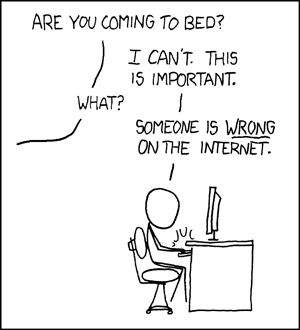
Sometimes, XKCD just speaks to me. Not often, because I’m not a huge math/physics nerd, but sometimes.

And happily, unlike Cory Doctorow, I’ve more-or-less managed to keep that resolution for the past year or two.

Crossposted with klech.net
davidklecha: Listening to someone else read the worst of my teenage writing. (Default)

A few notable things.

First is that Anthology Builder is hosting my one published short story, “Refuge” is available there. Not that you should go there just for that–there’s tons of good fiction there, and all of it deserves a second look.

I’m also liking this, incidentally, because it means when I do buy an anthology, I can provide links to the stories I liked (or liked best) here, directly to where you can buy them or preview them.

Second is that we finally had to convert my son’s crib to a toddler bed this weekend. Wednesday night he took a hard fall from it after trying to climb out. Scary moment, when I heard the hard thump on the floor, but he’s very much okay. (And just to prove how okay, he started reciting the alphabet without prompting or having it in front of him this week. Got it memorized, he has.)

The bummer is that the guardrail we bought for the bed is too big and not suited to these crib convertibles. I rigged it to make it work, but it’s still not quite ideal, so we’ll be looking for something else soon. Also, when he woke up this morning he actually waited for me to get him out of bed, which was … well, nice. Especially since I’m pretty sure he woke up before I did.

Crossposted with klech.net
davidklecha: Listening to someone else read the worst of my teenage writing. (Default)

Nancy Fulda, who I know through the Codex Writers, has come up with one of the coolest ideas for the future of short fiction: Anthology Builder.

The idea?

Authors submit stories there–reprints, all–and readers can go there and pick up stories ala carte and build their own hardcopy anthology. I think the anthology idea is fantastic and could well help extend the life of individual short stories and allow for more word-of-mouth enjoyment of short fiction.

For now, the site is in beta, and as of right now most (all?) of the authors are Codex Writers, but I’m pretty hopeful that the idea is going to catch on and take hold and be really successful. Go check it out, I’m pretty sure you’ll dig it, too.

davidklecha: Listening to someone else read the worst of my teenage writing. (Default)

When one publishes something, for better or worse, they are putting it out there, placing it on display, making it public; that is, after all, the core of the word. The creator, as much control as he or she had of it up to that point, no longer controls the work to a nontrivial degree.

Certainly, copyright law has all kinds of specific conditions and whatnot as to how much a copyright holder controls the copyright, but really… that’s a commercial thing. I’m not well-versed in its intricacies (though, anyone following the SFWA/Doctorow stuff of late might start to think they qualify as IP experts what with all the know-how being chucked about), so I’m going to take the time-honored tack of ignoring it entirely.

I’m more interested in the cultural applications, anyway.

Or maybe it’s the practical.

At any rate, I feel like… once you put something out there, it’s out there. Your control over it is limited. The best–the very best–you can do, given how national economies are structured, is control the sale of it, when actual money changes hands. Though even that is limited, and often the subject of diplomatic hand-wringing (at least when the big copyright holders start leaning on their elected representatives). But that’s about it.

You don’t have control over which libraries buy a book, for instance, nor over how many people borrow it. You can’t dictate how many friends one lends the book to, or how often it is re-gifted. Hell–you can’t even make an inch of headway on how many times an individual volume is resold. No author can stop anyone from going on television and telling viewers to buy only used books. They can’t even manage to get Amazon to stop advertising used books on the same page as new.

The funny thing is, the culture has always managed to place value on an author’s output in spite of the many cheap-as-free ways of getting their work, prior to the internet age. That value has seemed to decline in recent years, to some degree, and especially in comparison with movies and music and video games, but it’s still been there, and some would insist more people are able to make money writing than ever before.

So I wonder at the wisdom of those who would suggest that allowing works to roam free on the internet is tantamount to cutting one’s own throat. Has the culture lost the ability to place a value on work? In the very worst case, if everyone becomes so enamored with freebies that they buy no creative output whatsoever, then there simply will not be any new output for them to pass around. Perhaps at some point this will not be a problem since there will simply be so much freely available that no one person could get through everything out there, but it doesn’t seem likely.

But clearly that’s not so. The culture still values creative output–and supporting the creator–even if the essence of it is available for free. John Scalzi may well still have Agent to the Stars available as shareware out there, somewhere, but it sold well enough in hardcover that Tor feels like they could make money on it selling it in paperback. Howard Tayler gives away free the bulk of his creative output, and yet still manages to sell massive quantities of printed versions of his work.

If a freebie culture caused the devaluation of the thing that was given away, clearly Scalzi and Tayler should have been among the very first to be affected negatively, rather than affected very, very positively.

And so, I find it frankly astonishing that, as the cornerstone of a group’s copyright policy, they should name two particular websites as targets of interest for aggressive negotiation and conciliation. Seriously? That’s like pursuing an agreement with the occlusal surfaces of teeth #3 and #4 of the hydra’s sixth head such that they will not grind on you if you happen to be eaten by it.

Once a book is published, it’s almost certainly going to be digitized and distributed. The only reason it would not is that no one cares about it, in which case the author has much bigger problems. The technology of distributed file sharing and the reality of sovereign, foreign entities that don’t have to care about domestic law is going to be enough to ensure that that book is going to be out there, meandering around.

There is no deterrence, other than not to publish. There is no strategy that addresses aggressive moves against a couple of distributors that will not need to be applied to every distributor. The RIAA has pursued that strategy to its logical conclusion, and wound up suing seven year olds and computer-free grandmothers. And like in the negotiation with the hydra’s teeth, there is no end to the fight once engaged.

The solution, of course, is making friends with the hydra.

Profile

davidklecha: Listening to someone else read the worst of my teenage writing. (Default)
davidklecha

January 2013

S M T W T F S
  123 45
6789101112
13141516171819
20212223242526
2728293031  

Syndicate

RSS Atom

Most Popular Tags

Style Credit

Expand Cut Tags

No cut tags